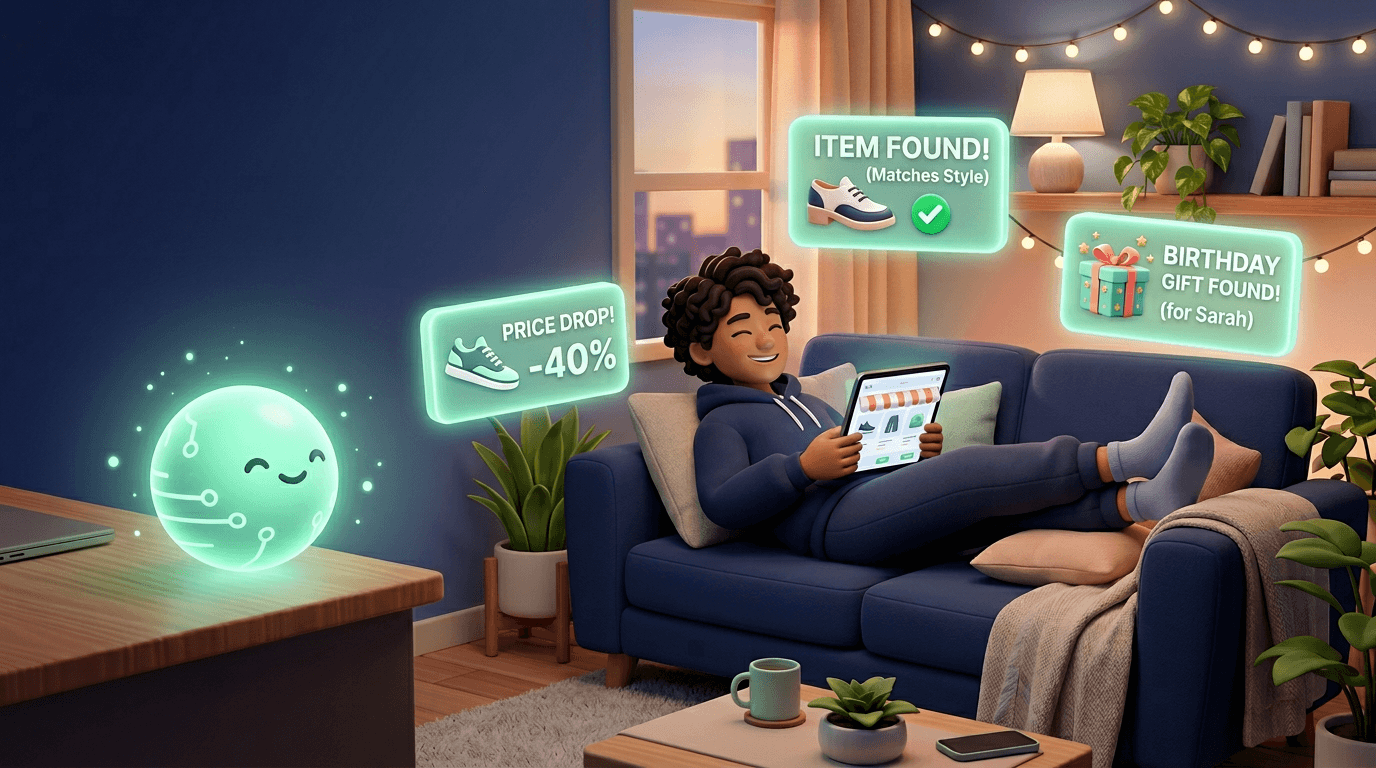
Your Personal AI Shopper: How to Set Up ASI:One to Find Deals You Would Miss
You are already comparison shopping across 15 tabs. Your AI could be doing that while you sleep - and it already knows your size, your budget, and that your friend's birthday is in two weeks.
You spent 40 minutes last night comparing running shoes across six websites. You had 15 tabs open. You read the same review three times. You still did not buy anything.
Your AI could have done that while you slept. And unlike you at midnight, it would have remembered your shoe size, your brand preferences, and the fact that your current pair has 400 miles on them.
That is the difference between a price alert and a personal shopper. One watches a number. The other knows you.
Why Generic Deal Bots Fall Short
Price-alert tools know one thing: the number you typed in. They do not know that you only wear wide-fit shoes. They do not know that you prefer sustainable brands. They do not know that you need a gift for your mom's birthday in two weeks and she is into gardening.
A price alert tells you when something is cheap. That is not the same as telling you when something is right.
- Price alerts Track one product, one price. You do the rest.
- Browser extensions Show coupons at checkout. They do not find what you should buy.
- Deal aggregators Blast everything on sale. No filter for what you care about.
These tools solve the wrong problem. The hard part of shopping is not finding a discount. It is finding the right product in the first place.
What Makes Your AI a Personal Shopper
Your AI in ASI:One is not a deal bot. It is a personal shopper that learns who you are and uses that context every time it searches for something on your behalf.
- Memory Knows your sizing, brand preferences, past purchases, and budget constraints. You tell it once - it remembers.
- Preferences Understands your style, favorite brands, and the price thresholds where you actually buy.
- Recurring tasks Scans for deals on a schedule you set - daily, weekly, whenever. It runs while you do not.
- Social context Knows your friends' birthdays, upcoming events, and group plans. It shops ahead for people you care about.
- Shopify integration Browses products from Shopify stores and surfaces them directly in your conversation.
- Payments Handles transactions when you are ready. No switching between apps.
The Personal Shopper Difference
Set Up Your Personal Shopper in 5 Minutes
No settings pages. No configuration screens. You set up your personal shopper the same way you would brief a real one - by talking.
Step 1: Tell your AI what you like
Start a conversation and share your preferences. Be specific. The more context your AI has, the better it filters.
Your AI saves this to its memory. You do not need to repeat yourself.
Step 2: Create a recurring task
Tell your AI what to scan for and how often. This uses recurring tasks - the same feature that powers morning briefings and weekly research summaries.
Step 3: Add social context
This is where your AI goes from useful to indispensable. Tell it about upcoming events and the people in your life.
Step 4: Let it run
Your AI scans on the schedule you set. Results show up in your conversation - with context about why each item matched your preferences. No push notification spam. No inbox flooding. Just a message waiting for you when you are ready to look.
Step 5: Review and buy
Your AI does not just dump links. It tells you why it picked each item, how it matches what you asked for, and what others think about it. You make the call.
Three Setups That Save Real Money
Most people start with one recurring search and end up with three or four running at the same time. Here are the setups that work best.
The Daily Deal Scanner
Pick the categories you buy most - running gear, coffee, skincare, whatever. Set your AI to scan daily. Use the thumbs up and thumbs down icons to signal what landed, then reply with details about what you liked or did not - that context goes straight into your AI's memory and sharpens every future search.
The Gift Finder
Add the birthdays and events that matter. Your AI shops ahead - not the night before. It knows the person's interests because you told it (or because it picked them up from your conversations).
Pro Tip
The Travel Deal Hunter
Combine your AI's flight search capabilities with deal scanning. Tell it where you want to go, your budget, and your flexible dates. It watches prices daily and alerts you when the math works.
Your AI Gets Better Over Time
Every result your AI sends has thumbs up and thumbs down icons. Tap them for a quick signal. But since your AI delivers results as a single message, a vote alone only tells it something was off - not what.
The fastest way to sharpen your results is to reply through chat or voice with context. "That brand runs narrow, only show me wide-fit options" or "I liked the style but $90 is too much for a t-shirt" - one sentence, and your AI saves it to its memory system. That filter applies to every search from now on.
After a month, your AI stops showing you things you would never buy. It knows the difference between a deal and a deal for you. That is the gap between a notification and a recommendation.
This is what separates a personal AI from a chatbot. A chatbot answers when you ask. Your AI works when you do not ask - because it already knows what you need.
Where This Is Going
Keep Reading
Stop Comparison Shopping
Your AI knows your size, your budget, and your taste. Set it to scan for deals while you sleep. Five minutes now saves hours every week.