What Happens When Every Community Member Gets an AI
One organizer does all the work. Everyone else consumes. That's the current model. What if every member had an AI that carried their share?
The Current Model: One Organizer, Many Consumers
Every community you've been part of has the same structure. One person does the work. Everyone else shows up.
Think about the community you joined and abandoned. The group chat that went quiet after two weeks. The channel that started with energy and devolved into silence. There's a pattern, and it's not your fault for noticing it.
One person - the organizer - carries the community on their back. They schedule the events. They send the reminders. They moderate the discussions. They onboard new members. They resolve conflicts. They answer the same questions for the tenth time. They keep the energy up when nobody else is contributing.
Everyone else consumes. They show up when it's convenient. They read what's posted. They attend what's planned. They leave when the organizer stops carrying the weight.
The organizer burns out. It's not a question of if, but when. The work is invisible until it stops. And when it stops, the community dies. Not because nobody cared, but because nobody was equipped to share the load.
This is the community platform problem. Every chat app runs on the same broken model. One person does the digital labor. Everyone else benefits. The platform grows until the organizer can't keep up, then it stagnates.
The AI-Native Model: Every Member Has an Assistant
What if the work wasn't centralized in one person? What if every member had a personal AI that carried their share?
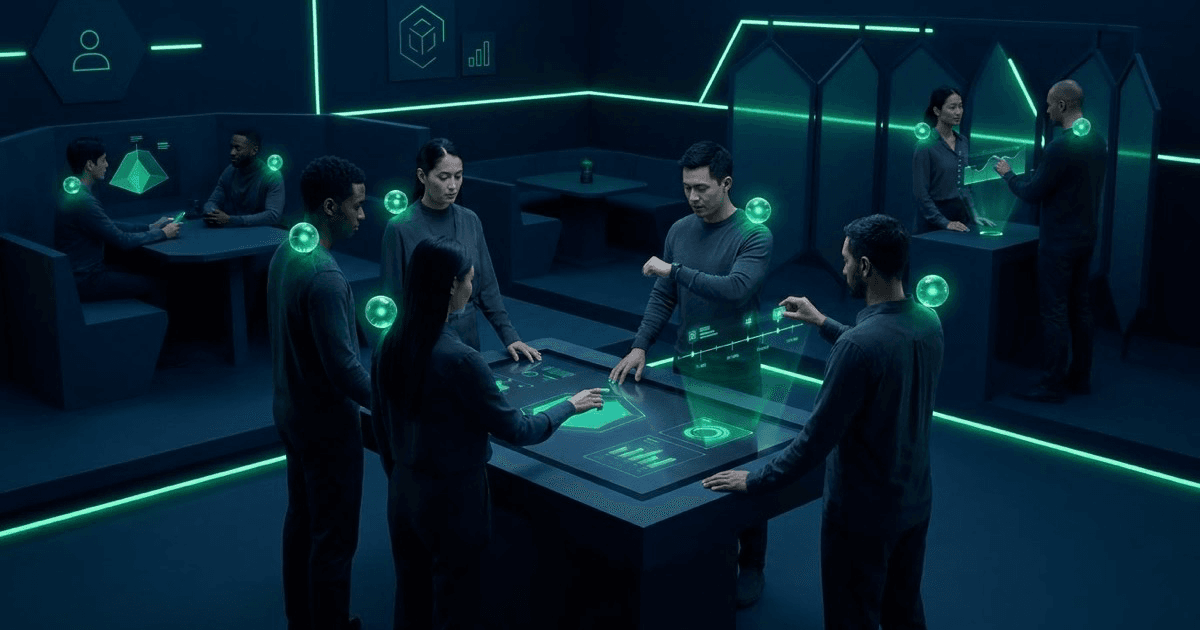
Not "the community has an AI." That's just another tool for the organizer to manage. The shift is bigger: every single member gets their own AI. An AI that knows their schedule, their preferences, their commitments. An AI that handles their digital overhead so they can participate without it costing them their evening.
Your AI filters your notifications so you see what matters. It coordinates your plans so you don't have to run a poll. It answers your questions so you don't have to wait for the organizer to respond. It handles the digital work that makes participation feel like a second job.
The organizer's role changes. They stop managing logistics and start leading vision. They set the direction. They decide what the community is about. They don't send reminders, schedule polls, or answer "when is the next event" for the hundredth time. Their AI handles that. Every member's AI handles that.
The member's role changes too. They stop consuming and start participating. When participation doesn't cost them three hours of scheduling back-and-forth, they do it. When their AI handles the coordination, they show up. Not because they're more committed, but because the friction is gone.
The Key Shift
AI-to-AI Coordination
Here's where it gets interesting. When every member has an AI, those AIs can talk to each other. Not about you. For you.
You've been in this conversation. Someone says "let's do something this weekend." Forty-seven messages later, you're debating Saturday versus Sunday, hiking versus brunch, who's driving, what time works for the person who has kids. Two hours of your life. Maybe a plan. Maybe not.
When every member has an AI, that conversation looks different. Your AI checks your calendar. Maya's AI knows she's free Saturday after 2pm. Jordan's AI knows they prefer hiking. The AIs negotiate directly. You get the result.
One message in. One message out. No polling. No "when works for everyone." No endless thread. Your AI coordinated with five other AIs, checked five calendars, compared preferences, found the overlap, and made the plan. You didn't do anything except say what you wanted.
This is what AI-to-AI coordination makes possible. Not one AI running the community. Every member's AI handling their piece of the coordination. The labor is distributed. The result is delivered. You spend your time experiencing the plan, not making it.
The Network Effect
Here's the part that changes everything. In the old model, more members means more work for the organizer. More people to schedule around. More questions to answer. More conflicts to moderate. Growth is a burden.
In the AI-native model, more members means more AIs. More AIs means more coordination capacity. More capacity means more events get planned, more connections get made, more value gets created. Growth is an asset.
Each new member doesn't add load to the system. They add capability. Their AI brings their schedule, their preferences, their network, their skills. The community gets richer with every person who joins, not more strained.
The community becomes self-sustaining. No single point of failure. No organizer whose departure kills the group. The labor is distributed across every member's AI. If one person leaves, the community keeps running because the coordination capacity is in the network, not in one person.
Why This Compounds
The Outcome
Communities that run themselves. Organizers who lead instead of manage. Members who participate instead of consume.
This is what happens when every member gets an AI. The digital labor that kills communities - the scheduling, the reminding, the moderating, the answering - gets distributed across a network of AIs that handle it automatically.
Organizers get to be leaders again. They set the vision. They decide what the community is about. They build the culture. They stop being project managers and start being the people who make the community worth joining.
Members get to be participants again. They show up because showing up doesn't cost them three hours of coordination. They contribute because contributing doesn't mean volunteering for the scheduling poll. They engage because their AI removed the friction between "I want to be part of this" and "I am part of this."
More time in reality. Less time on screens. The AIs handle the digital layer so humans can focus on the part that matters: being together, building something, showing up for each other.
This isn't a future we're waiting for. Every member of your community can have an AI today. The network effect starts with the first person who joins and brings their AI. It grows with every new member who does the same.
The Bigger Picture
Keep Reading
The Community Platform Problem
You joined a community to belong. Instead you are managing a chat app full-time. The problem is the platform, not you.
Read MoreThought LeadershipThe Community Organizer AI Guide
Moderation, onboarding, and coordination run on autopilot when every member has an AI that carries its share.
Read MoreCommunity AISpheres: A Home for Your Community
Every member brings their AI into a shared home. The community is the point, and your AI is the partner that keeps it running.
Read MoreGive Every Member an AI
Stop running your community on one person's burnout. Give every member a personal AI that carries their share. The community runs itself.