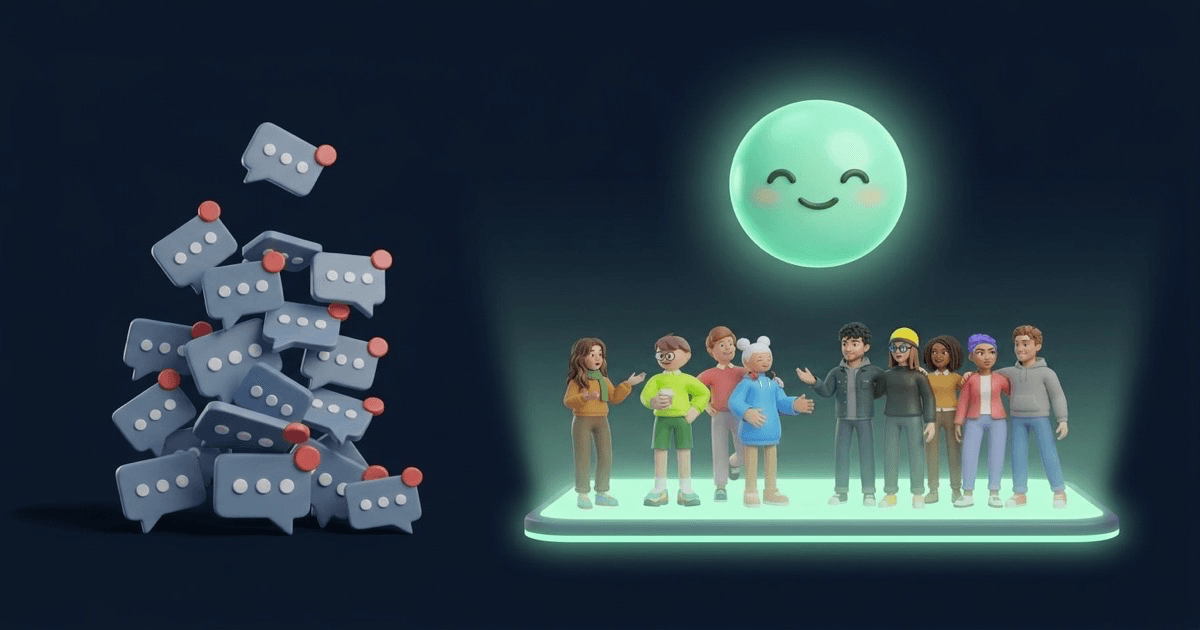
Why Chat Apps Break Communities at Scale
Chat apps work for 20 friends. They break for 200 members. The problem isn't your community. It's the architecture underneath it.
Chat apps work for 20 friends. They break for 200 members. The problem isn't your community. It's the architecture underneath it.
Every community starts the same way. A handful of people who care about the same thing, talking in one place. The chat app is perfect for this. Everyone sees every message. Nobody needs structure. The energy is real because everyone is there.
Then it grows. And the same architecture that made 20 people feel close makes 200 people feel like strangers. This isn't a moderation problem or a culture problem. It's a structural problem. Chat apps are built for conversations. Communities are built out of people. Those are different shapes, and the seams show at scale.
This is the second half of the community platform problem. The first half named the pain. This post shows exactly where the architecture gives out, member by member, as the community grows.
The 20-Friend Illusion
Chat apps create an illusion of community that holds until roughly 20 active participants. Under that number, everyone knows everyone. Messages are read, not skimmed. Questions get answered because someone sees them and has context. New members can read the history and catch up in an afternoon.
Past that number, the assumptions behind chat architecture quietly fail. The first assumption: everyone reads everything. The second: the scrollback is a reasonable place to look things up. The third: one channel can hold one conversation. Each of these was true at 20 people. None of them survive 200.
Communities feel this as a vibe shift, not a technical event. The energy drops. The same questions repeat. Regulars stop showing up. The organizer works harder for a community that feels smaller than the member count says it is.
Where the Architecture Gives Out
The collapse follows a predictable sequence. Four structural failures, each one triggered by the community doing the one thing it wants to do: growing.
1. Coordination drowns in notifications
At 20 people, planning an event is 10 messages. At 200 people, it is 200 notifications, most of them irrelevant to most of the members. The people who planned the event burn out on logistics before it starts. The people who would have come never see the thread. Attendance drops, and the organizer blames the event instead of the channel.
2. Knowledge evaporates into the scrollback
The best answer to the community's most common question was posted three weeks ago. It is now 4,000 messages deep. New members ask again. Regulars answer with links nobody can find. Organizers maintain FAQ docs nobody reads. The community's collective wisdom exists, but it is functionally unreachable. Every cohort relearns everything from scratch.
3. Moderation becomes a full-time job
At 20 people, a heated debate is a conversation. At 200 people, it is an incident. Someone has to watch the channel, enforce the rules, and defuse conflicts before they escalate. In chat apps, that someone is a volunteer with a phone. The bigger the community gets, the more it needs professional-grade moderation and the further it gets from having it.
4. New members hit a wall
The first message a new member sees is the middle of someone else's conversation. There's no orientation, no context, no map of who's who. The strongest members push through. The rest never come back, and the organizer never finds out why.
Why More Channels Don't Fix It
What Scale Requires
A community that wants to grow needs capabilities a chat app structurally cannot provide, because chat apps are built to move messages between people who are already present. Communities need systems that keep working when most members are not.
- Memory that outlives the message: Answers should stay findable months later. A new member should be able to ask the community a question and get the answer the community already knows, without scrolling through history or waiting for a regular to reply.
- Coordination that runs in the background: Scheduling should not require 200 people to read 200 messages. Time and place should be found, confirmed, and reminded without anyone moderating the process.
- Moderation that understands context: Communities need a first line of defense that can tell the difference between a passionate debate and a personal attack, and can act before the organizer is even online.
- An onboarding that welcomes: A new member should arrive to context, not to the middle of a conversation. They should know what the community is, who is in it, and what to do first.
These four capabilities share one requirement: something has to be paying attention to the community all the time, even when nobody is online. That's a job for software. But chat apps are built to deliver messages, not to pay attention. You can't bolt attention onto a message pipe.
The AI-Native Answer
What changes when the community's shared home has an AI partner built in? Every structural failure gets a structural answer.
- Coordination: Members' AIs find the time, place, and headcount together. You get one confirmed plan instead of a notification flood. Nobody plans logistics. Everyone shows up.
- Knowledge: The AI partner remembers what the community discussed and surfaces the answer when the question comes back. The community stops repeating itself, and its knowledge compounds.
- Moderation: The AI partner enforces the community guidelines around the clock, flags the cases that need a human judgment call, and hands the organizer a summary instead of a shift.
- Onboarding: New members arrive to a welcome that carries context: what the community is, what is happening next, and who to talk to. The first hour stops being an accidental filter.
The point isn't adding AI to a chat app. It's that the community's home has a partner whose job is the community itself. Chat remains what people do there. Attention, memory, and care become what the platform does for them.
Communities don't break because people stop caring. They break because the platform gives them nothing to care with. Give the community a partner that holds the structure, and the structure holds the growth.
Keep Reading
The Community Platform Problem
You joined a community to belong. Instead you are managing a chat app full-time. The problem is the platform, not you.
Read MoreThought LeadershipThe Group Chat Is Lying to You
Everyone is typing. Nobody is saying anything. The group chat has 47 unread messages and zero decisions made. Your AI can fix that.
Read MoreSocial AIThe Community Organizer’s Guide to AI
Moderation, onboarding, and coordination run on autopilot when every member has an AI that carries its share.
Read MoreGrow Your Community Without Breaking It
Your AI handles coordination, knowledge, moderation, and onboarding so your community can grow past 200 members without collapsing under the work. Create your AI and give your community a partner that scales with it.